
Traditionally, golf shafts were, and still are, described with weight and stiffness ratings. Weigh is specified in grams. Stiffness is a letter, L, A, R, S, X or a number, 5.5, 6.0. 6.5. That tradition remains on most golf shafts to this day. When I learned club fitting many years ago I was introduced to shaft profiling by Tom Wishon. He took frequency measurements down the shaft. I came to the understanding that knowing golf shafts involved how stiffness is distributed along the shaft. I learned that shaft engineers used EI profile measurement. They designed shaft properties with software that predicts EI profiles and then validate manufactured prototypes with EI measurements. The instruments they used to measure EI profiles were expensive and not affordable to the club building and club fitting community. Having spent my career selling and often designing factory material handling equipment, I had the skills to design and build an instrument to measure EI profiles. My design was massively less expensive than the instrument the shaft engineers used and was specifically designed for golf shaft measuring. Many shaft manufacturers now own & use my instrument.
EI measurement is an engineering text book process. Suspend a beam of material between two supports and lower a weigh of a known mass in the center of the beam. The deflection of the beam is the EI factor. It is used in structural design to understand the bearing weigh of a beam. This was concept was applied to golf shaft design. Because the shaft stiffness varies along the shaft, readings are taken inch by inch to “profile” the shaft. Because tubes deform when the weight is applied the text book process had to be modified. With the help of Dave Tutelman we incorporated hoop deformation into the EI formula.
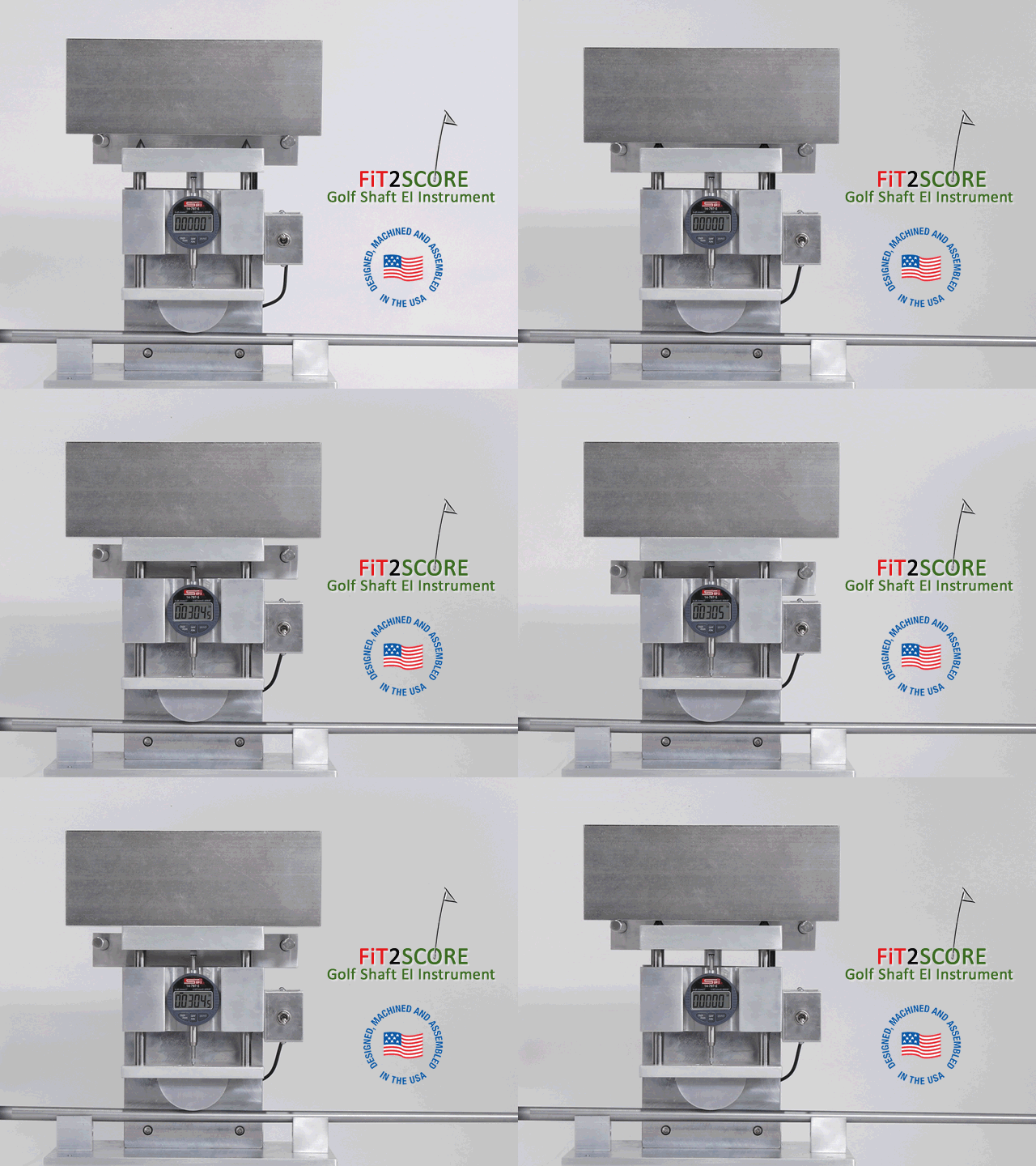
Before EI, there was no uniformity in shaft stiffness ratings. And simply rating the stiffness of a golf shaft did not convey an understanding of the distribution of stiffness down a shaft. EI profiles are not the same thing as flex. You can think of flex as a classification of a shaft by a manufacturer. EI profiles are the underlying resistance to the bending of the shaft at measured intervals down the shaft. Initial experiments made it clear to me that a 1″ measurement interval was needed to understand resistance to bending down the shaft.
A traditional way of describing shafts was to use the term “kick point”. A golf shaft doesn’t have a single “kick point”. Shaft deformation is a continuous shape determined the shafts stiffness distribution and the forces applied by a golfer’s unique swing. Stiffness distribution of a golf shaft is defined by point to point EI. In its simplest understand, EI is an engineering property defined by stiffness of the material and the amount of the material. Without getting too technical, “kick point” implies a shaft has a hinge at a single point. In fact, a modern golf shaft will have multiple hinges that influence it’s shape during the golf swing. Knowing the EI profile of the modern golf shaft is how to compare shaft stiffness and bending characteristics. The EI curve shows the shaft’s resistance to bending. It does not show the shaft’s dynamic shape during your golf swing. Here we see the EI profile of three drive shaft archetypes.
The Yellow curve shows a firm mid shaft, Blue mid neutral and red mid soft. Each of these shafts have nearly identical overall stiffness. But as you can plainly see, they will play differently. The EI profile is just one of many properties of a shaft that interacts with a swing. In general, mid stiffness, to a large degree affects forgiveness of a shaft. A mid firm shaft is the least forgiving. And much like how golf club heads, it is best fit into a player that has the ability to actively control shot shape.
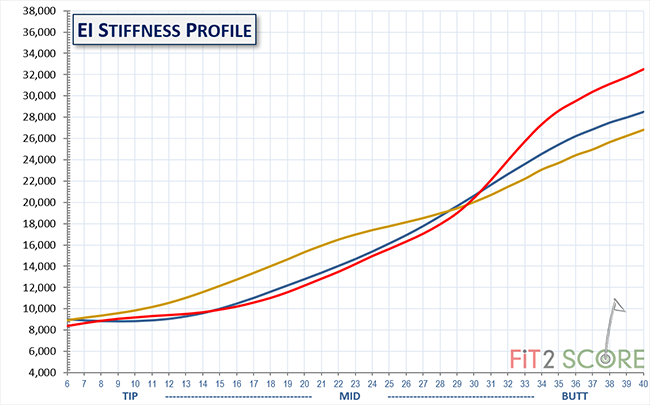
A mid soft shaft tends to be the most forgiving. It absorbs inconsistent loads at release. The result is less variance in delivery of the club head into the ball. Without an understanding of EI profiles a club fitter is blindly wandering through the fitting process. Perhaps guided by experience but lacking the knowledge to quickly select a shaft that matches a swing loading dynamics.
This article is a simple explanation of the role of EI profiles on fitting a golf shaft to a swing. The discussion of shaft property interaction with the golf swing in a recent ChatGpt discussion was 873 pages of text and illustrations spread across 54 lessons.